The Honeymoon
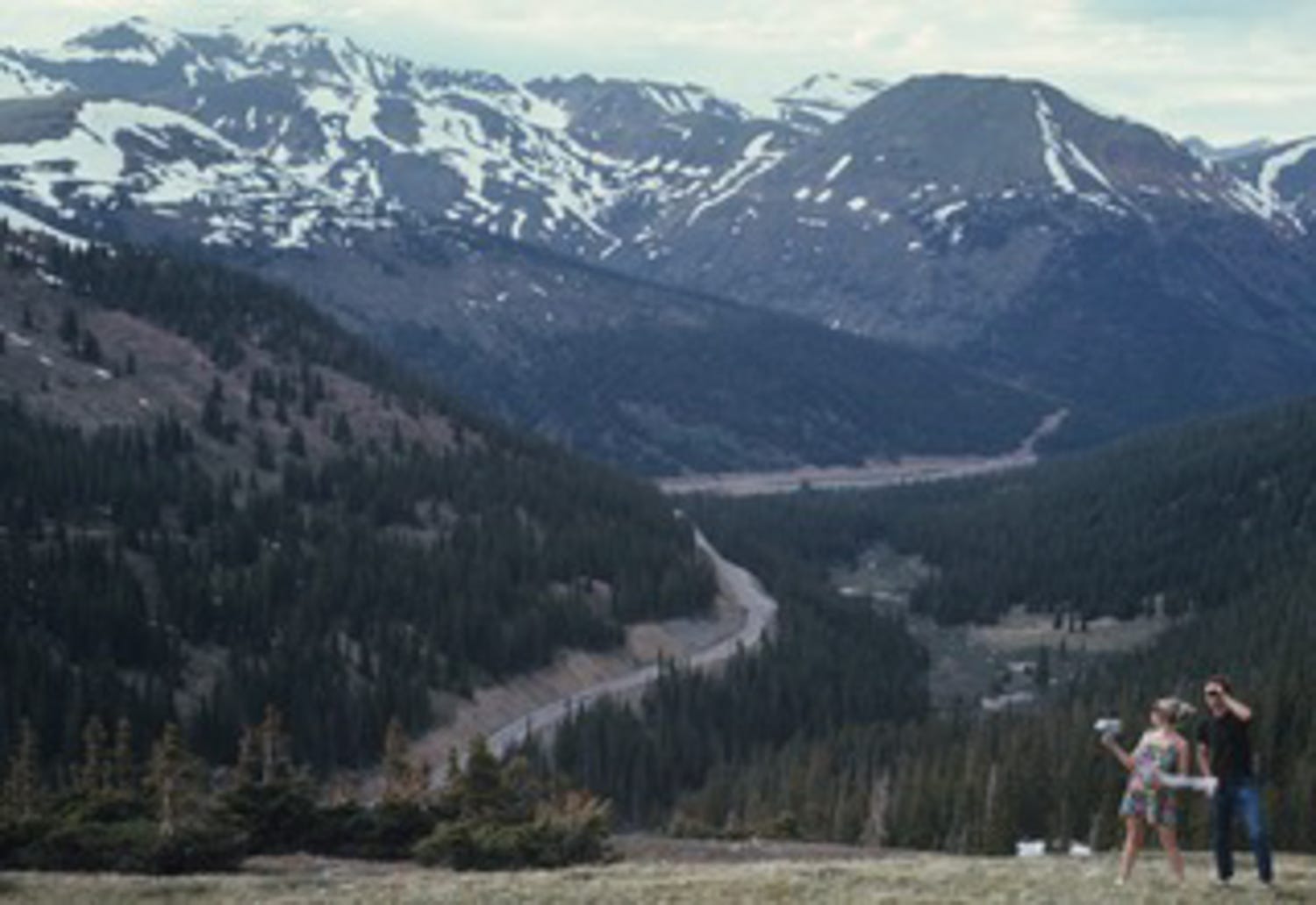
John and Katy Myers did go with us on our honeymoon trip to Kansas. They accompanied us all across the sparsely populated western states, sleeping in camp grounds and random pull-offs that happened to coincide with the internal evaporation of any strength for further driving. Katy’s beautiful moonface always looked stoned and blissful, and her smile was a constant feature of her demeanor. Myers was more ironic, and he looked slightly incognito in his full and already graying beard. He fixed the van starter in the middle of nowhere and told us why the land looked the way it did. We all enjoyed the solitude and adventure and washed our aluminum cookware in cold streams, while wood fires sent columns of sage scented smoke into the pristine air, above the high plateaus. It was great to escape the city and the television set, which had become an ugly, news-driven addiction for me.
John Boestrom had ridden down into Oregon with us and then bailed out on the afternoon of the first day to begin the process of hitch-hiking to Arizona. Before leaving Seattle, we had picked an entire grocery sack full of ripe cherries from the tree in our back yard, and we passed the bag around, spitting pits out into the flow of the perfect June breeze. Snow-covered Mount Hood was visible as the van followed the Columbia River, east towards The Dalles. Our house was subleased to a visiting University of Washington academic and his family, and they had agreed to take care of the guinea pigs for the summer. They wrote us letters and told us that their kids had learned to identify each one by name, using the detailed descriptions that we had left in the house. We left Seattle before their arrival, and arrived home after their departure, so these letters were all we would ever know of the family that we had found through the housing assistance office.
Our first night on the road was spent at the edge of the Newburry Crater, near Bend, Oregon. The volcanic crater had become a clear, cold lake that sat at the base of the world’s largest obsidian flow. Before setting up camp, we explored the glass moonscape and fought off clouds of mosquitoes. The next day we continued south and passed through miles of superb desolation, on our way to Winnemucca, Nevada. The sign on Highway 95, near McDermitt, had warned us that possession of marijuana in Nevada could land us in jail for life, so I packaged up a joint and mailed it to Dinah, from the post office in Winnemucca, a terrible town that was all plastic and whores and dust.
Myers and Katy guided us to a magical site called Angel Lake, high in the mountains of eastern Nevada, about ten miles from the “Stinker” gas station at the edge of Wells. The campground was still partially filled with snow and cold water rushed down from the semi-circular theater of peaks and into the basin, which was hidden at the end of a serpentine climb up a road that had no name or number. We spent the next morning playing Frisbee on the Great Salt Lake Desert, which was flat and white and trackless. The place presented us with a strange lack of scale that made catching the black saucer very confusing and difficult. It was fun until the abortive trip to find the ghost town of Mercur, which landed us in the middle of a nest of hostile gun freaks in pickup trucks, who yelled at us about “private property” and didn’t rest until we got our freaky asses back out onto the interstate.
At the Colorado border we stopped to spend the night at Dinosaur National Monument. Before darkness settled we watched serious-looking guys in smocks and hard hats chip away at the Stegosaurus bones that emerged from the rock matrix in low, convex relief. There was snow above the timberline in Rocky Mountain National Park, and disappointment in Broomfield, where we learned that Clark Richert had moved to New York City. We had been counting on him for a place to crash. Myers and I drove through violent rainstorms in eastern Colorado and into Kansas on 1-70, looking in vain for all night radio signals. In the sparsely populated counties of western Kansas, the people seemed to be outnumbered by irrigation pumps. The manicured, misanthropic farm sites reminded me of the acreages I had seen in photographs that accompanied an article about the African country of Rhodesia. White farmers there were outnumbered by local blacks twenty to one, so their farms looked like armed camps. I’m not sure who the farmers in Gove County were hiding from. “Libertarianism” maybe? It was dawn when we finally arrived in Lawrence and got Voldeng out of bed and lit up a pipe of hashish. He was living on Maine Street, not far from our old digs at 837. He had a row of corn growing at the base of the front porch, where most people would have geraniums. There’s no place like home, we said.
Voldeng invited us all to take a nap, after our long day and night of travel. Herschy went up and dived gratefully into bed, but I just took a bath and headed up the hill to see what was happening at the Rock Chalk. I encountered Pam Davis, and we proceeded to get drunk. She got kind of sad and misty-eyed, with her hand in my hair, drinking Virgil’s offerings on tap, sideways out of the pitcher. Chickie and John arrived about noon, followed by Stoner and Mery Jacobs. We all agreed that we needed to have a party to celebrate our recent marriages, so I bought a keg, and we put the word out that there was free beer and free love and free Hughie out at Hood’s farm. Herschy arrived, fresh and rested, about the same time that Annie Albrecht gave me a hit of Dexadrine to put me back on my feet.
Roger Doudna, who lived in the so-called Coach House was still the king of the Frisbee, especially on his home court, which included the 12th and Oread Street intersection and the green hillside outside the Rock Chalk. Out at the Hood’s farm, just off the highway John gave me some more speed and I talked sentimentally with Chickie, while she smoked and slumped against their VW in the muddy driveway. Eventually the keg went dry, the hysterical energy evaporated, and Herschy and I slept in the van, a pair of really fried honeymooners.
The next day we walked around the farm in a light rain and checked out the dilapidated interior or the house, while trying to jump-start the day with coffee and toast. We shuffled through the rubble of nocturnal nonsense, which included plastic cups, half full of beer and floating cigarette filters. I told John I preferred to see the plastic cups as half full, rather than half empty and he looked at me with a pained expression. He and Chick still had my “Mid-America” prize winning painting, but since it was nine feet tall and the little farmhouse had eight-foot drop ceilings, the painting sat diagonally against the south wall like a lean-to. They were happy to be out of Chicago and at the end of an unmarked country lane, but they were struggling with a still unplanned and directionless future, so we all brainstormed about what we could do with our lives, once we had the final reunion in River City. I never doubted that I would come back, once I had my MFA. What a strange obsession this spot on the map was.
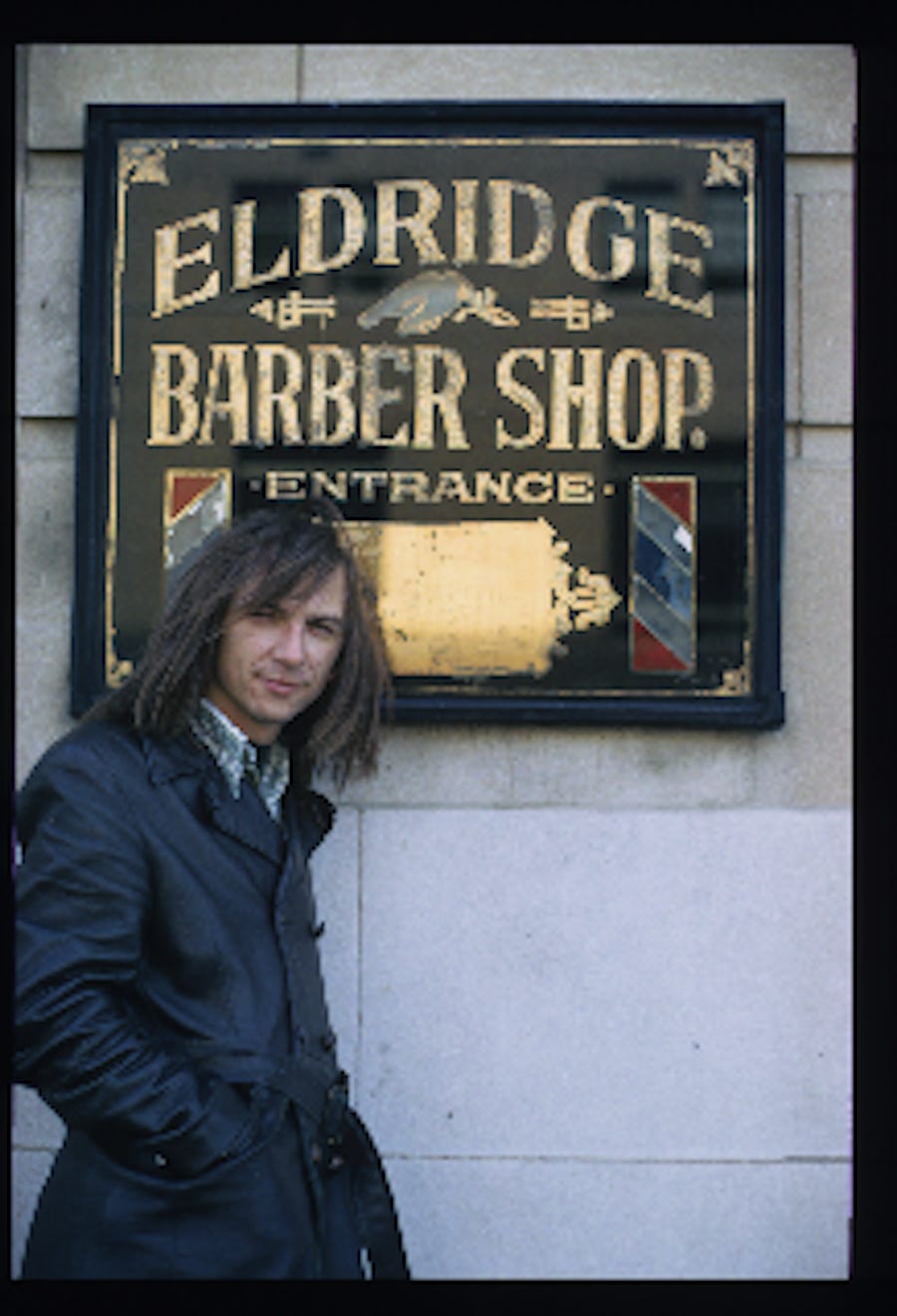
Herschy and I visited Tim and Ellen, another pair of recent newlyweds, and checked out the new head shop called Strawberry Fields that had recently been opened by Kim Kern and Jenny Russell. The front door featured a window that was built in the shape of a peace sign, and it tickled me when I realized that the store, which was at 712 Massachusetts, occupied a space that was once a barber shop. Their inventory was a fascinating blend of imported items and roach clips and Art Nouveau spin offs, including the latest black light and pop festival posters, with tantalizing bits of nudity, strobe candles, massage oil, and left-wing chic in many forms. Unlike the Prince of Darkness shop, which was now gone, Strawberry Fields looked like a viable business.
Paul and Cele Wood looked cute and happy. Cele was five months pregnant, looking fertile and leggy in that plaid miniskirt. A lot of things looked just like we left them. Weedle sat in front of the Rock Chalk, under the sign in the window that asked, “want a cheap thrill?” Watson looked just as slippery and dangerous as ever, smirking and palming a joint and squeezing the ever-spooky Leslie Lewis, who had bleached her hair but could not manage to tell me one thing that had happened to her in the time since we last crossed paths. Pam Davis now had a 250cc BSA, and she wore mirror shades and an organic looking crash helmet that was another of Ray Wilber’s industrial age mojos. Lee Campbell had taken a 1969 Freak Photo in my absence, and it was on display at the Chalk. Some hippie boy in the front row had dropped his pants for the camera and the faces were numerous, mirthful, and young. Bobbie Kessler removed her top and posed for me in those denim hip-huggers. That sweet face and those gorgeous tits just stuck to the 120 film like a decal from a Kansas variety store. I guess I must have tripped the shutter, but it all seemed effortless and dreamlike.
Back at Voldeng’s we connected with McCrary, the Kottmanns, and the Halls. In the late afternoon, when the locusts had begun their hypnotic vocal undulations, we all watched Alpha males Pete Voldeng and George Kimball laugh and collide, chest to chest, with each other, like a pair of elephant seals. There was no cover charge. We all grinned and put cans of beer to our foreheads like cold compresses.
After a few days in Lawrence, Herschy and I ran Mery to Topeka and then took a carload of helpless, stranded hippies to Wichita. As always, Wichita was unchanged, but Aaron was in constant metamorphosis. He told me what an orbit was, and then we took one of his insolent robots that refused to perform its tricks and busted it up into dozens of pieces and took his picture with the dismembered body. We went to the movies to see Peter Pan and to escape the Sedgwick County heat. It was so much fun to see him, but I felt more like some out-of-town uncle than a real father.

Trudy and Tom and Aaron were living out on a farm, quite a distance north of the city. She said that Fontelle and Val had gotten married and they were living in Los Angeles, but news from them traveled slowly, because it was sent so seldom. My guess is they must have broken up by then. The truth was, I had sort of lost interest. Trudy looked beautiful but she was a sad-eyed lady of the lowlands, out in the dust bowl, on the border with Harvey County, with Tom was often away a lot on quests and errands that were male and mysterious. Again, it seemed sort of Old World to me. I never understood men who didn’t like to be with their women.
This Canadian kid named Mark was staying with my parents. He had ridden the bus down to visit from Winnipeg, after hearing tales of Wichita from Jeannie and Tony. He was a sweetheart, but it was a puzzling kind of a pilgrimage, and I felt sorry for him when we finally put him on a Greyhound in late June. Earl and Audrey came to my parents’ house to help hand-dig a “well” in the backyard and eat watermelon in the shade. After the first fifteen feet, my dad struck something hard and unyielding and we all turned our attentions to the visit by Stoner and Mack Roop, who were astride Stoner’s new 350 Honda. I took it for a spin and was impressed. Mack Roop was one of those people that stories accumulated around, sort of like Watson, who was supposed to have been killed in a shootout in Mexico. Mack was supposed to have walked into the sea and never come out, like the Norfork Lake hiker of my childhood. That story was repeated by countless River City freaks, including Becky Balding, who had the hots for Mack. Weird things did happen to him. The last time I had seen Mack, he was lying in the middle of Oread Street, with ambulance lights moving rhythmically across his face, ripped on LSD, paralyzed from a pummeling by Tom Brand. He seemed to be doing OK in June of ‘69. He had that roguish smirk back. They left, and we went back to the drawing board on my father’s water well, but a lot of communal sweat yielded very little progress past fifteen feet, and the project was eventually abandoned. With good $3 a month water from the city of Wichita, I’m not sure why my father wanted a hand dug well. I never asked him. He was just doing his thing, man.
That night Herschy and I went drinking with Bucachek at the Black Out. After a few beers, we took a warm, moonlit walk in Maple Grove Cemetery. At 3:00 A.M. we went skinny-dipping in the private swimming pool of some east Wichita apartment complex, accompanied by a cute, working class couple that we met. His name was Larry and he worked at Beechcraft and rode a BSA chopper. His girlfriend Paula was a blonde, sexy go-go dancer, who put the stem of an artificial rose between her teeth as they blasted off down Lincoln Street on the big twin. They were sweet, non-threatening swingers, always ready for action and laughs and a party of some sort. He wore his shades and had an insistent, upbeat nature that was compelling and endearing. The pool shimmered in stillness, and the strange quiet and warmth of the Wichita night drove us out of our clothes and into the scent of chlorine and the glow of pale and distorted nakedness. Paula led the way, brandishing her gravity-defying tits, lit by the blue, bug-filled light that emanated from the edge of the pool, followed by Larry, who sipped whiskey, and told jokes, while the rest of us splashed like children or baptized each other in the perfect liquid of continuous innocence. Shortly before dawn, the paper boy threw several Wichita Eagles into the courtyard, and his double-take convinced us that it was time to put on our suits and say good-bye forever.. After a couple hours of sleep, Aaron and I were climbing on the roof of my parents’ house and rooting around the old pickup. It was just another day in Wichita’s fast lane.

Our next stop was St. Joseph, where Herschy’s brother John would soon be leaving for Europe. The welcome in St. Jo was warmer than we expected, but it wasn’t long until everybody started yelling about the war in Vietnam. One of Herschy’s old boyfriends, George something or other, was horrified to see how she had “ended up” and it was a tense evening of political polarization and you-can’t-go-home-again object lessons. I tried to make myself useful around the house from then on, bailing out the boat and stripping furniture on the patio, trying to think of bland, generic topics of conversation to dredge up when more high school friends and their parents showed up to view Judy’s hippie husband. We drove John to the airport, and he flew off to foreign adventures just in time to miss a day and night of violent weather that included tornadoes and heavy rain. There was storm damage on some of the family property near the stockyards, so we did a tour of inspection and talked about insurance and capital gains with Ray and Beverly. They were really great to us, after all the years of conflict, but I couldn’t wait to bail out of the real world and get back into the subterranean morass.
It was just a couple of hours back to the alternative lunacy of Lawrence. At Voldeng’s place, we admired the night from the upstairs window. It was hot and the moon was full. The electric fan oscillated and rattled softly.
I went to visit Pat Roper, who was sequestered in a dreary little cinderblock apartment near Iowa Street. She fixed iced tea and left the drapes closed. It was cold and dark in the apartment, and she seemed content to ignore the true nature of that June morning, which was bright and hot and humid. We had been a little bit in love in the spring of 1967 and I guess we were still a little bit in love. I think the lack of true and unqualified adoration between Herschy and me had made us both unwilling to give up the fragmentary passions that existed between us and other people. Pat was quiet and dignified, but strangely forthcoming, and I liked that about her. She accepted and trusted my nature in ways that Herschy never had, and this phenomenon troubled me. We were, after all, barely acquainted-- but the openness between us surpassed what Herschy and I had managed in three years of cohabitation. I was not there to fool around, less than a month into my second marriage, but it was uplifting to see Pat and feel all that attention and approval. She changed and posed for the Hasselblad later in the morning. The light streamed in through the sliding glass doors once we pulled the drapes back, but the cold, processed air continued to surround us as we transformed her into another incarnation of the goddess. I asked only for a slight tilt of the head and a little fine-tuning of the cascading dark tresses that circled a pale breast. I was easily entertained.
On July 4, the weather was so hot that we were driven in great numbers into the water at Perry Reservoir, northwest of Lawrence. Even Pim Helms dived into the silt-colored lake and laughed and snorted like Quasimodo at a garden party. Forcade and Ellen splashed and sunned themselves in a tangle of limbs, looking like newlywed blades of grass. Dan and Susan Hall were there, talking about their plans to move to the Northwest and Cheri Smith showed up with her new hubby Ken Hallberg, who seemed in over his head with the man-eating Cheri plum, who had just turned nineteen.
I plundered Herschy’s two-piece bathing suit under the cool, opaque water and then felt myself being plundered by sly Cheri, who had one of those old-time jailbait smiles and wet, recently dyed hair plastered across her forehead. What a ride this guy Ken was in for! John and Chick had gone to St. Louis, to visit the Chick’s parents and they missed the spectacular fireworks display that we watched in the black heat, on the hillside under the KU Campanile. O0000h. Aaaaaaah. And so on.
After their return, we took them to see the dream house that we had found in Lawrence, at the corner of 15th and Pennsylvania. The nineteenth-century brick house sat back from the street in a thicket of trees, bushes and irises, and it had a three-story tower on one corner that contained a dramatic staircase. In the front room the windows stretched all the way to the floor. The lady who lived there was friendly and wonderful looking, with wild, white hair and a cute hook nose. She said that her name was “Mrs. Turney” and she was a widow, but the house was not for sale. That was disappointing, but it was still fun meeting her and seeing the old house. Lawrence was full of these Victorian gingerbread houses, and in 1969 most of them hovered on the edge of neglect, occupied as they were by aging, retired residents who could no longer keep the wood painted or the bricks pointed. It was the perfect time to buy one of the tattered mansions, but we procrastinated, thinking they would always be in ample supply.
Another week in Wichita gave me the chance to touch all the bases with Aaron. He went with Herschy and me to “Joyland,” where we rode rocket ships and bump ‘em cars and the breathtaking roller coaster, which climbed up and over the pinnacle under the sign that read “last warning-- do not stand up-- keep hands inside car,” before the face flattening descent down G-Force Hill. The Joyland train still passed under the roller coaster and over the dry drainage ditch that was filled with dead branches and old hot water heaters, before winding its way into the fragrant, unspoiled woods that hid teenage couples who groped and whispered in the chigger-infested grasses. The life- sized clown with the malevolent, frozen smile still “played” the complex, mechanical calliope in the center of the park, watched by children from Wichita trailer courts, with faces full of awe and suspicion, stained by Sno-Cones and stuffed with refined sugar products. The hands of the robot clown passed back and forth across the keys of a faux keyboard in low, unerring arcs that were unrelated to the outbursts of organ pipes, chimes, and drum rolls that layered themselves over the squeals of preschoolers and the ritual shrieks of girls on the Tilt-o-Whirl.
All of us failed miserably at the bowling concession, but Aaron managed to knock down two out of three cloth cats that sat yowling on a wall, with the baseballs provided by the cigar-chomping man who gave away plaster statues and purple fuzzy bears and the rubber knife that Aaron won for his dead-eye accuracy. I made him an aluminum charm that said, “Aaron Brown is crazy,” by steering an arrow on an armature towards each individual letter on a clocklike display and then pulling a heavy lever that felt like a one-armed bandit. Toward the end of the evening, we all squeezed into a photo booth and immortalized four grotesque poses for twenty-five cents. By the time we left Joyland, the evening had turned balmy, and the locusts had finished their cacophony of surges and screeches. Aaron was exhausted but contented when we tucked him in at 1001 Fabrique Street. My parents listened carefully to every adventure, as he recited the day’s events with uncanny detail. Being with Aaron was truly magical and before we left Wichita, I made up my mind to return to Kansas, once I received my MFA. This kid was too good to see twice a year.
There was one more pilgrimage to River City, before the trip turned back to the West. We helped Ray Wilber put an air conditioner into the window of his sweltering apartment, but it was a gloomy event because the absence of Pam Davis was felt in every corner of the place. She had gone to New York with Bob McNown and Ray seemed pretty low. He would soon meet his true love, but that was no comfort in July 1969. Dinah Stone came down from Lincoln and stayed a couple of days at John and Chick’s place. She met Herschy and the Hoods for the first time and we got to play with her daughter Darcey on the farm, or at the Rock Chalk, watching the boys do wheelies on their Bultacos. Dinah woke us with kisses when the sun streamed in on the midsummer mornings and the humidity rose and hovered above the cornfields. The grasshoppers parted like the Red Sea, as we walked through the shadowless noon of another July day. Dinah’s winter of despair had given way to weary hopefulness and the realization that dropping out of life was not an option when you had a small child who deserved a running start. On July 20 we stole twenty-seven ears of corn from a nearby field and organized a freak feed at Hood’s dilapidated country retreat. The cornsilk and prairie grasses looked just like the sun-bleached tresses that belonged to Chickie and Herschy and Dinah, as they nibbled at the buttered and peppered ears and chattered agreeably, while steering Darcey away from misadventure with bumblebees and departing traffic. I did a photo shoot of Dinah and Darcey, against the patina of the wood grain on another abandoned farm building that sheltered clouds of mosquitoes and fragments of forgotten machinery from the baroque period of the American Industrial Revolution.
July 20 was also the day that American astronauts first walked on the Moon, fulfilling President Kennedy’s pledge to put a man on the moon within the decade. Unfortunately, it was Richard Nixon who presided over the event. At Paul and Cele Wood’s rental house we watched the simulations and listened to the rehearsed platitudes on a capricious old console TV set. As in the Christmas Eve orbiting of the Moon, we were unable to share in what should have been universal celebration. The event was too entangled with the perverse technological “can-do” spirit that was finding bigger and better ways to rain death and ecological catastrophe onto Vietnam’s people. It wasn’t long until the head shops were full of newspaper posters that featured a photograph of Neil Armstrong standing in the lunar dust, under the headline that read “SO WHAT?”
Full Circle
At the end of July, we left Kansas and headed southwest toward a planned rendezvous with Herschy’s brother Hank and his family in San Diego. Myers and Katy did not go with us-- they had made other arrangements to get back to Seattle, after a visit with Katy’s family. The trip across Texas, New Mexico, and Arizona was interesting and free of any serious trouble. Herschy caused quite a stir when she walked braless into a Dalhart, Texas, truck stop. The waitress and all the truckers couldn’t keep their eyes off the twin points that quivered under her T-shirt. We got our milk shakes to go and split for New Mexico, where fierce electrical storms tracked across the vast, sandy horizon, and billboards beckoned to us to come see live rattlesnakes. buy Indian curios and receive free samples of uranium ore. We took turns driving and covered a lot of ground that first day, finally pulling off the road to sleep at around 4:00 in the morning, somewhere in the Arizona desert. The night was quiet, and it blossomed with stars, but the all-night trucks rocked the van with irregular passes and accompanying gusts of turbulence. We didn’t really need sleep anyway-- we were high on youth and born to be wild. As soon as the sun appeared through the back window we ran joyfully out into the desert, looking for a place to piss, and then I cranked up the Dodge and parted my hair with a wet palm for the upcoming day of travel and foraging. Near Williams, Arizona, we stopped at a place that advertised “All You Can Eat for 69 cents.” We yucked it up and snarfed the food down, while the parking lot filled with station wagons and tractor-trailers. The drivers mopped their brows, talked about vapor lock, and waved the flies away from slices of banana cream pie.
Needles, California, shimmered in the ungodly midday heat. It seemed unreal. West of town, in the middle of the Mojave, the radio from Barstow said that it was 115 degrees there. I felt light-headed and drank glass after glass of water that Herschy drained from the cooler. Waiting for the van to cool a bit, we parked and walked into the noonday wastes, south of the highway and took pictures of each other, nude and giddy, casting naked shadows on the rock and dusty succulents. Our bodies were stroked by the hot air that rose and circled above the barren landscape. The sun hung motionless above San Bernardino County and the Bristol Mountains, driving the desert animals deep into the earth and creating firestorms of thermals for the buzzards to ride, turning the highway into a series of illusions and surreal truck stops that dotted the empty expanses. We put our clothes back on and retreated to the van, where I gripped the steering wheel and tried to clear my head. It was no wonder that, nearby, Charlie Manson, who was already crazy, and his homicidal harem, were turning paranoid and having trouble thinking straight.
The van scaled the lifeless-looking mountain ranges and joined Interstate 15, as the afternoon waned and the desert heat turned to an evening chill. Hank, Maria, and their son Kenny welcomed us to their upscale suburban house, steering us toward the showers and providing us with a can of cold beer just after sundown. In the darkness, as we unloaded, the sea could not be seen-- but it could be heard and felt, along with the strange melancholic exhilaration that comes with being a flat-lander on the edge of the land.
Hank and Maria were glad to see us, and they were great hosts, putting gadgets and food and drink at our disposal until the eerie pleasures of the American Dream swirled around us like cologne. We enjoyed the gin and the central air-conditioning; the big shower that had no rusty fixtures or outbreaks of mildew and the baseball game on the color TV that looked like a huge, hand-colored postcard. I had never been in a whorehouse, but the cheerful tile and matching towels made me imagine I was in Las Vegas. Clean and unfamiliar sheets felt sinful and sweet. I fancied that I was Mary Tyler Moore’s houseboy and sex slave.
Our hosts took us to Tijuana on a Sunday, where I bought two Italian switchblade knives and squirreled them away in my Mamiya-Sekor bag, for smuggling across the border later that day. We all strolled and shopped with our hands in our pockets, ate questionable platters of Mexican food with gusto, and looked for bargains in the trashy markets that were peopled by men with predatory eyes, who personified the love-hate (mostly hate) relationship between our countries and tried to slip a little grab-ass in with the ritual bartering and multilingual small talk. Herschy and Maria were brave and dignified in the midst of all the ugly and frantic hustling: the gold teeth and calloused Baja hands like mittens. I participated in the jaunty slumming but secretly I was terrified. I couldn’t understand why the desperate-looking Mexicans didn’t just kill us gringoes and take our money, instead of barking for it like seals. Mexico was a scary place, if Tijuana was any indication. All the shouting and diesel smoke and airborne grease from funnel cake stands were intimidating to a boy from Andover. Later, when everybody started buzzing about a possible camping trip down the Baja coast, I eagerly agreed that it sounded like a lot of fun.
We spent a week at Hank and Maria’s place and at the nearby beach, playing with their son Ken and nursing sunburns. I stole a glance down into Maria’s freckled bosom as she unloaded rows of identical drinking glasses from the dishwasher and reflected on feeling like a Zulu tourist visiting the White House. We got on well with Hank and Maria, even though they were kind of straight and relentlessly clean-cut. I could feel a kind of mutual need to taste the fruits of the others’ consciousness. I didn’t want to be like our hosts, but it was a relief to be free briefly from our outsider status and the bohemian script that had to be followed when we were with our peers. Our hosts enjoyed their brush with weirdness too. Judy had defied her parents when the chips were down, whereas Hank and his knocked-up sweetie had been obliged to knuckle under and play the parts of Ken and Barbie to atone for their indiscretions-- and having us under their roof imbued them with a little vicarious rebellion.
The camping trip to Baja California was a relatively timid adventure but we did manage to get down the coast far enough to break free of the forbidding ugliness of Tijuana and Ensanada. Late in the afternoon we put the van in low and charged up onto the top of a small, steep hill that overlooked the ocean and clamped on the brakes, stopping short of the gut-wrenching descent into the water on the west side. I made a campfire from two by four scraps and desert brush. The surprisingly cold surf battered a complex and uninviting bay beneath us while beef stew warmed and a mustard-colored column of smoke drifted toward the trackless interior of North America’s Sinai. It was an uneventful outing. Hank fished from the top of a wet, gray overlook and caught a “sea hare,” while the rest of us chatted with divers who emerged unexpectedly from the cold, churning tide. That night, Hank, Maria, and Ken slept in the van, while Herschy and I blithely spread sleeping bags onto the desert floor between the fading campfire and the Dodge. A last-minute check with a flashlight revealed that the ground had suddenly alive with scorpions, so we ended up putting the bags on the roof of the van, sleeping a fitful and convex kind of sleep until the welcome red dawn.
We had hoped to touch all the bases during our full circle honeymoon, but we could not find Val Stecklein and Fontelle Angle, who were living somewhere in the bowels of Los Angeles. In San Francisco there was a serendipitous reunion of Lincoln, Nebraska, expatriates at Wilson and Nadra’s new digs on Montcalm Street. Carlson had just been discharged from the army and that recent tour of duty had further honed his nihilistic sensibilities. As always, Carlson was in frat boy drag, but he was at least as crazy as Wilson and me, and his conventional appearance made his bizarre observations and outbursts all the more disturbing. John Riddell had moved his collection of wonderful shit to the Bay Area, and it was fun to see him, but it was kind of depressing to learn that he was working in an art factory, painting stage three on an assembly line that cranked out several canvases per hour. He said that paintings would arrive at his station with washes of color that represented the major features of San Francisco Bay, and he would add the sketchy references to bridges and architectural details. On down the line, other painters added flocks of birds and watery reflections. By the end of the day, a carload of these original works of art would be on their way to the gift shops near Fisherman’s Wharf and North Beach. What the hell-- it was a living. It did enable Riddell to engage in his true artistic achievements, collecting and partying.
With the addition of Will and Barb Fowler, we were able to put together a hell of a jug band. Fowler plucked at the guitar strings while Riddell and I worked out on the spoons and sang “Sal’s got a meat skin hid away,” or “Daniel served the living God while here upon this earth he trod.” Herschy giggled, Wilson snickered, and Nadra beamed supportively. Barb sucked on a joint and then dreamily tuned the autoharp between numbers. Ellie Mae Moritz and her long-suffering husband Doug were back together and living in flower town. Ellie had faded just a little, but she was still attractive and still gave me that unsettling full attention that conjured up an image of her sitting at the edge of a blanket in Lincoln’s Pioneer Park. Doug and Ellie had taken up smuggling, and they had fistfuls of unwise photographs, showing them with suitcases of money and contraband. Eventually they would open a Bayberg boutique with their profits but in 1969 they were freshly flushed with the exhilaration of creating stacks of cash from clandestine sea voyages and exotic ports of call. Sleepy Gene Vermillion had come to San Francisco from Wichita, and he sang of bad luck and trouble that was just the same on Haight Street as it had been on north Douglas. He and Charlie Musselwhite were the blackest white boys we knew. Ace Williams had a new sweetie from North Carolina (cute as a speckled pup) and I’m not sure where that new guy named “Hogwalker” came from, but he was digging the jug band, and he kept laying French kisses on me. The party lurched forward with good-natured perpetual motion until Carlson, without warning, dumped a big grocery bag full of popcorn on all the musicians. Although the things Carlson said and did once he was fucked up rarely made much sense, we took them as signs from one who was infected by the ultimate wisdom of madness. Soon after the popcorn-dumping incident we all packed it up and resolved to party another day.
It was a short visit with Wilson and Nadra. Herschy and I were anxious to get back to Seattle and prepare for the fall semester. Before we left, I looked at all the latest smut for Zap and Snatch comics. Wilson’s drawings, always insightful and wickedly funny, were developing new cohesion and a signature style. He and Nadra seemed reasonably happy, although I wondered how long Nadra, a real smart and talented lady, would be content to work dreary jobs and cook and clean for a continuously stoned arteest. Wilson worked hard, but it was a very narrow band of endeavor. The relationship would hold together for several more years and in that time Wilson, Crumb, and others would preside over the golden age of underground comics.
Being stoned was an important part of producing the stream-of-consciousness stories and images for most of these artists. “Jomos,” sequential cartoons that were passed around or mailed to other artists, tested improvisational skills and helped shake up any tendency toward comfortable cliches. Each cartoonist responded to the content and story line of the preceding artist’s frame and dangled another loose end for the next participant to tie up. Wilson did several jomos with Jon Gierlich, who continued to live in Anacortes, Washington. Theirs was a love-hate relationship and a kind of artistic mixed marriage. Gierlich’s esoteric and cerebral disciplines went beyond the academic, while Wilson relied on a strictly intuitive blend of EC Comic inspiration and personal, drug-induced exploration. They admired each other but couldn’t resist a little conceptual or territorial scrap once in a while.
Gierlich was ultimately as subversive as the next guy, but he was not really part of the drug culture. I had the feeling that he considered the experience a kind of intellectual blunt instrument-- or maybe, like me, he just didn’t enjoy being high. In any case, he pimped Wilson about his pipe dreams and Wilson railed back about art establishment lap dogs. Wilson had been busted for possession shortly after arriving in San Francisco, and although the bust never resulted in any jail time, it tormented him with lots of paranoid uncertainty, soaked up a lot of his limited resources, and obliged him to interact with the ugly world that he had worked so hard to drop out of. Just before we left Flowertown for the final leg our journey back to Seattle, Wilson showed me a recent letter he had received from Gierlich. The letter itself was brief and uneventful, but the packaging was a masterpiece of creative harassment. The business-size envelope had a clear window, meant to display the pre-printed mailing address of some utility or insurance company. Wilson’s address was written off to the side and the window revealed what resembled a packet full of marijuana, although it was actually oregano. An arrow pointed to the enclosed vegetable matter and a note read, “here’s the stuff, Wilson.” Times being what they were, I was amazed that the letter had ever been delivered intact. Wilson was no doubt working on some form of pen pal revenge as we crossed the Bay Bridge and looked across the glittering water to Berkeley and the mainland. We droned north on Highway 5 and talked about the upcoming year.
Unknown to us at the time, Lawrence hyper-hippie Steve Nelson was engaged in a disastrous experiment in real drug smuggling. Nelson was slightly younger than Wilson and me and he earnestly emulated our rebellious ways, especially the reliance on LSD for spiritual guidance. About the time I was deciding that drugs had been mostly unkind to me and did not merit much further attention, Steve Nelson was becoming a passionate acid head. I was puzzled and a little envious of those blissed-out droppers like Steve, who giggled and were endlessly entertained by linoleum floors or tangles of string. LSD unlocked playful worlds of color and revelation for them, while I was stuck mostly with the Dantesque.
I never knew anyone who tried to fly while tripping-- those delusions were really pretty rare- but the “insights” gained on these trips were comically and tragically dubious. If Steve Nelson did not know that before his encounter with smuggling, he certainly did afterward. His basic plan seemed reasonable enough. American Customs agents, anxious to lock up the long-hairs, would be searching every nook and cranny of his luggage, especially since his itinerary included Morocco, a well-known depot for cheap and plentiful hashish. Steve decided that if he returned by way of Canada, refuge for American draft dodgers, and then drove through the low security frontier, the chances of being busted were greatly diminished. Even if he did get busted, those Canadians could take a joke, right? Like many acid heads, Steve also felt more confident and tuned in to the cracks and seams of the establishment’s “power trip” when he was high. He therefore decided to take LSD for the border crossing, so that he could outwit and charm the hapless border police, who did not have the benefit of chemically enhanced perceptions. Like Gus before him, Steve’s self-medicating hunches were unreliable in the extreme.
The bricks of tan hashish were hidden in socks that became large, rectangular, aromatic Argyle packages, lurking at the bottom of the suitcase. The real defense against arrest, however, was to be his near invisibility, brought on by the magical effects of LSD. Steve was just beginning to rush and his eyes no doubt looked like pinwheels when the officers on the Canadian side of the frontier somehow penetrated his force field and asked him to bring the luggage into the pulsating, paisley security room. The socks looked like snakes who had just swallowed cinder blocks. When a cop held one of them aloft and asked what was inside it, Steve blurted out “hash.”
The result of Steve Nelson’s psychedelic pratfall was ultimately not very funny. He spent several years in a Canadian prison, robbed of his liberty because an alternative intoxicant was, and is, forbidden in North America. Herschy and I heard of Steve’s arrest about the same time that Dan and Susan Hall were popped in Lawrence. What none of us knew at the time was that the offending hashish that was confiscated on the Canadian border was on its way to another Lawrence drug dealer and armchair revolutionary named Burke Scagnelli, who drove a Maserati, and was often in the company of a beautiful theater student named Christy Brandt. Of course, I knew Christy only as the pensive dance-hall girl who appeared in the newspaper photo with Becky.
In 1969, many of our friends and peers in Lawrence had begun to grow or harvest marijuana and some built up respectable nest eggs that eventually set them up in legal businesses. The reasons for being in the dope business were many, but in the early days a missionary’s wish to “turn on the world” was an important one. Also, it was a way of making a living that did not require you to turn over part of your income to the war machine. Although few counterculture people would have seriously advocated the elimination of the army in a dangerous world, many did object to paying for expensive and immoral adventurism in Southeast Asia. Some became addicted to the excitement of operating outside the system and the thrill of violating the rapist. Of course easy money became addicting too, not to mention the use of the drugs themselves. Eventually, when the drug culture separated from the ideals of the dewy-eyed hippies, easy money and being high were all that was left, and nearly everybody still involved descended into darkness. More about that later, of course.
The autumn of ‘69 started right up with very little pumping or priming. I was now an accepted part of the art establishment at the University of Washington and everything else was in place for picking up where we left off. A nice family from Colorado had lived in the house for the summer, courtesy of the university housing service. They had arrived after we left Seattle and departed before we returned, so we never really met them, but there had been mail and phone calls. They said they loved our wacky house, and the kids had enjoyed taking care of the guinea pigs. The place was immaculate when we arrived. Except for the weird household items, you could almost imagine that normal people lived there. I painted the house in exchange for a month’s rent, another of my sly business moves. It took weeks, on the top of a swaying ladder, but at least the weather was picture-perfect, and I was in the prime of youth, so no harm was done. It was time to trot out the new football team at the University of Washington. Herschy and I went to the fish market to score some scallops and looked over the “Huskies” poster, which had a schedule of games and a photograph of the unsmiling, all-meat players. The starting center was a burr-headed, no-neck Neanderthal whose name was Dick Hard. Not Richard, but Dick.
The driveway was full of motorcycles in the fall of ‘69. Gierlich and Heiser had scored an old telescopic fork BMW, on which they toured Whidbey and Fidalgo Islands, stopping in at Ft. Casey and some of the charming old port towns to soak up the scarce sun and collect artifacts. Don Kottmann was still piloting that black Triumph. Melinda Kottmann had bought a Bultaco “Metralla” and let her bobbed hair grow to sensuous new lengths. Manifestations of Melinda’s new independence would soon progress past the symbolic. John Holmes had a beautiful new bride named Merilee who could stop your heart with one flash of those dark eyes. They owned several motorcycles, including a wonderful little baby road-racer built by Cimati that Holmes regularly picked up and held in his arms for photographs. McNown got a new BSA Victor and a new rose tattoo in the early autumn.. Herschy and I had our “his” and “hers” Yamahas, which we polished and took pictures of, as if they were our children.
At the university, I was assigned a 7:00 A.M. beginning drawing class. My adaptation to the new schedule was only partly successful. As the fall wore on and the days grew short, I found myself riding the Yamaha in a pitch-black drizzle, on my way to a nearly catatonic collection of hollow-eyed freshmen. An hour into class, a faint illumination would appear in the east and repeated cups of coffee would finally jump-start the artistic process. It surprised me that, even with official approval, I was only a mediocre teacher. There was something about the wrapping of what you said and did into a package that could benefit the hopeless as well as the talented self-starters that made it all sound absurd and lifeless. One interesting thing did emerge from that class, however. In order to come to grips with who these kids were and what was the general level of their awareness, I gave them a list of people and terms and objects to identify. I told them that this test would not influence their grades-- that it was only for my information. The results were illuminating and at times very funny. Unfortunately, I threw most of the papers away, but I did save a few fragments and glue them in my scrapbook:
Flying Buttress: (1) “large bombing plane used in WW 2 or 1” (2) “rock band”
Existentialism: (1) “art once considered extreme”
“philosophy which dwells on the darker side”
“trend of thought”
“a current trend which underlies new thinking”
Nave: (1) “child-like, without adult sophistication”
Gore Vidal: (1) “Cuban leader- also a movie about his life”
“hairstylist”
“Gord Vival?”
“Gore Bibal. No idea”
Earth art:
“a type of art in which the artist tries to convey a message by digging a hole or piling dirt”
“would you believe cave man art?”
“work done in colors of earth”
Andy Warhol: (1) "cartoonist"
Rococo: (1) “a type of fancy art”
I threw a trick question in, using Bob Dylan’s real name, Zimmerman. He was identified as a “a modern artist, pop art type,” a “mountaineer,” an “athlete,” and so on. One student mused: “sounds familiar,” and another wrote, “he’s doing something right now but what?” I’m not sure if the test really helped me to teach the class but it provided Herschy and me with a lot of fun around the fireplace. The kids in that drawing class certainly knew as much as I had, when I started at WSU. There were no budding geniuses that I could recognize but most of them plugged away and showed up, including one girl who lived in the Cascade foothills, east of Everett. Every morning, she had to walk down a dirt road to the highway, thumb a ride to Everett and then another one to Seattle’s U. District. It was more than fifty miles, but she never missed a class. Sadly, her drawings were hopeless. It was a perverse universe, I thought, and tried desperately to come up with constructive guidance for my zealous little charge.
Kottmann, on the other hand, was a loose cannon, both as an artist and a teacher, but those who stuck with him probably progressed and learned more than my students. He and his wife Melinda had just discovered LSD in the fall of ‘69 and Kottmann always jumped in with both feet. On the morning of his first drawing class, he found himself still rushing on some dynamite shit and unable to relate to the concept of time. When it suddenly occurred to him that he had a class to teach, his condition made driving a car or motorcycle unthinkable, so he crossed Aurora Street and began to run in the direction of the university, a distance of almost five miles. When he finally arrived at the classroom, gasping, sweating, and wide-eyed, some of the students had already left. Those who remained were subjected to a diatribe on the meaning of art and life and told to come to class the following day with “100 finished drawings.” Half of them dropped the class that afternoon, but those who stayed were undoubtedly subjected to a real learning experience over the course of that semester. Kottmann believed in work and wasn’t afraid to be demanding. A simple recipe of hard work and an homage to German Expressionism eventually turned his own art around and resulted in an interesting thesis exhibition.
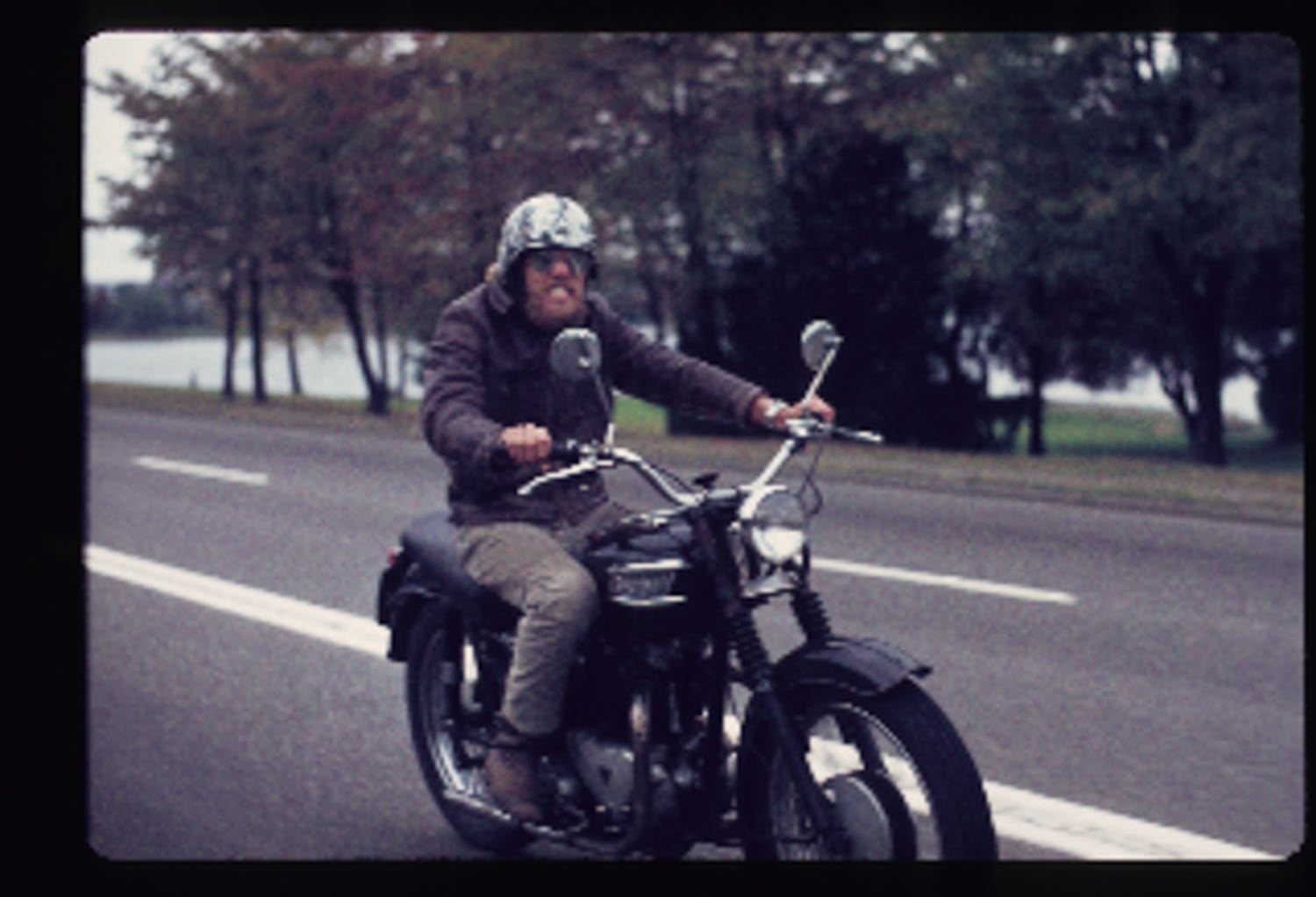
Ho Chi Minh never lived to see the Communist victory in Vietnam. He died the same week that Melinda Kottmann and I got in a terrible fight. She was drunk and fucking with my head at one of those parties that failed to gel into a collective agenda. Every time I turned the volume down to a level where a conversation could be had, she would turn it back up. This happened several times. Finally I ripped the Butterfield Blues Band record off the turntable and threw it at the wall, where it shattered into pieces and rained down onto the heads of some freaked-out newcomers, who had never met us before. Melinda left in tears and the rest of the party melted away, looking for better vibes. Later Melinda returned to the back door, still crying but ready for some heavy petting. Herschy went to bed and told me to put the cat out. Of course we didn’t have a cat. I said a few soft and conciliatory words to Melinda and submitted to her delicate, aggressive hands. It wasn’t too long before a weary-looking Kottmann arrived in the alley, on his burbling, baritone Triumph, to collect his pretty little lost soul. Her head went flat against his back, as they accelerated into the darkness.
The local underground rag featured a photo of Ho Chi Minh on the cover of its next issue and included one of his poems, which had been written in prison:
The wheel of the law turns
Without pause.
After the rain, good weather
In the wink of an eye.
The universe throws off
Its muddy clothes.
For ten thousand miles
The landscape
Spreads out like a beautiful brocade.
Light breezes. Smiling flowers.
High in the trees, amongst
The sparkling leaves
All the birds sing at once.
Men and animals rise up, reborn.
What could be more natural?
After sorrow, comes happiness.
Translated from Vietnamese, the poem was only marginally artful, but it conjured up an image of the poet warrior who knew what he was fighting for. He was also willing to give his life for only a part of the struggle, just as citizens and artisans in medieval Europe worked for generations on one cathedral, knowing that they would never see it completed. Ho Chi Minh embodied the Vietnamese spirit and sense of mission. I was still rooting for them, even if they were in bed with the Russian military. They didn’t have much choice, at this point. I tried to imagine Richard Nixon writing poetry in prison, and it was an obscene image. That night he was on television again, hinting about his “secret plan” to end the war. The death of his rival had filled him with unfocused, nervous exhilaration and it made him look, as somebody said later, like Ed Sullivan on speed.
As the rains began, Herschy and I settled in for some productive work, at home as well as at the university. Working on huge, empty landscapes, I began experimenting with the use of a print brayer, a kind of rubber roller, to apply some of the oil paint. Rolled across areas of partially mixed paint on the palette and then applied across the canvas, it created blips of rhythmic form that imitated some of the forces of nature. Atmospheric color shifts appeared in the form of water ripples or cloud formations, seemingly shaped by undulating upper-level winds. After some experience with this odd and specialized tool, I discovered that it could create highly controllable painting or wonderful accidents that could be co-opted by the resourceful artist who had a good eye. It was perfect for me, since I had that eye but not the endless facility of some. This approach also created what was for me the perfect blend of problem solving and input from the mystical collective wellspring that seemed to flow magically if you could learn to turn on the tap. Out of this experiment grew the beginnings of my “signature style,” which would give cohesiveness to my thesis exhibition and dominate my work for decades to come. It was an exciting moment, but I didn’t realize the long-term implications at the time. Herschy was, in many ways, already a more mature artist than I was, but she stayed mostly with drawing and seemed to hold back from the outpouring of work that I was sure was ready to spring from her hand. Unresolved spiritual impulses that she could not seem to sort out created an uneasy base of operations, from which she could only dabble and experiment. She studied French that semester and began what would ultimately become the most beautiful crazy quilt in the history of the world. Dinner parties at our house became gourmet events, thanks to Herschy’s increasingly sophisticated touch on the leeks and the salmon, but they sometimes ended up as drunken brawls anyway. One evening she came back from the campus with a carload of cute French sailors-- part of the crew of Jaques Cousteau’s research ship, Calypso. The boys were obviously disappointed to find a husband waiting at home, but they swallowed their dismay and partied with gusto, giving Herschy a chance to practice her French and them a rare opportunity for them to hear my hillbilly accent wrapped around Gallic words, like some white trash hors d’oeuvres.
Dan and Susan Hall arrived from Lawrence, having escaped prosecution on a dope picking incident. The collection of expatriate Kansans living in Seattle continued to grow, although the marriages within that group were as volatile as ever. Judy Heiser got tired of the Puget Sound honeymoon and moved back to Lincoln, leaving Gierlich high and dry in Anacortes. Pam Davis, who had broken Wilber’s heart to run off with McNown, now had bailed out on him and it was rumored that she was preparing to marry Stoner. “I’m a loser and he’s a loser and we deserve each other,” she was supposed to have told somebody. An intervention on the part of friends and family left Stoner weeping and Pam in the looney bin. When the dust had truly settled, she found the ultimate loser, a Booneville, Missouri, Juke car dealer asshole, and married him. Barbara, Jenny and Herschy, who would later visit Pam in Booneville, all agreed that he was the worst human being they had ever met in their young lives. During their visit, he came in with a bunch of his drunk buddies and got real offended when the girls didn’t want to fuck all of them. Pam later told them that one night he came home liquored up and pissed on her mother, who was spending the night on the couch. It was a textbook case of subhuman morons and the women who love them, but this was before all the self-help books had come along to give names to our various follies. Who could have predicted the avalanche of pop psychology that was just around the corner? Anyway, it was too late to save us from what we described politely as “learning experiences.”
Life in the subculture fast lane always included ritual sacrifice of brain cells and the trotting of marriages to the edge of the precipice, even in times of virtuous productivity and family bliss. At Michael Wright’s place, we resurrected Jimi Hendrix from the dead and turned him up as loud as he would go. I drank one of everything until the lights in my head switched off and I fell flat onto my face. After being carried home by several other party animals, I spent the gray hours of morning puking under the cherry tree, never once, that I can remember, asking myself why I had used a perfectly good northwestern night to fuck up so badly.
Melinda had gone from being a shy little mouse to a sexual empire builder. She, Kottmann, and Michael Wright performed from a complex Jules and Jim script that they made up as they went. The bitter ending was predictable, but nobody could bear to watch the end, so they wandered, lost and wired, across a landscape of unsupportable events and evaporating sensation. Judy Cotil, recently widowed Druid queen of Elk, California, arrived with David and Linda Hixon to visit us, along with Wilson and Nadra, who came all the way from Flower Town. Judy looked tattered but intact, as I engaged her in unfamiliar conversation, brought about partly by Methedrine, alcohol and hashish. Nadra had told me earlier that Judy was receiving messages from Gus in the other world, so I didn’t talk any Druid trash, just in case he was listening. Wilson and Gierlich sniped at each other and worked jointly on a painting of two contrasting biker chicks. Wilson and I snarled and kissed, and kept the troops entertained. David and Linda Hixon arrived from Elk, California. We hunted in intellectual packs and often fed on poison and despair, even when sweet and sustaining elements were within easy grasp. David and Linda, with their tolerant and benign natures, coaxed us back into the peaceable kingdom, from which we strayed more and more.
In November my father came to stay with us, while working a brief gig for Boeing. He drove the old Chevy pickup out from Kansas-- almost 2000 miles at 45 miles an hour. He was always a patient and deliberate kind of a guy. I could easily imagine the humble, frugal details of that journey- the search for low-priced “regular” and the Hostess “Sno Balls” sitting above the dead speedometer. I could smell the scorched oil from the engine block as the vapors crept through the firewall and trip out on the fan-shaped burnishing of the windshield.
It was odd, running into my father in the kitchen or the bathroom, seeing his lunch box on the counter next to the exotic packaged food that we bought at the Pike Place Market. He worked the second shift, so we didn’t see him much, but in the context of our newly created life as the young, artsy, cutting-edge sophisticates, his presence was like an old news reel about Harry Truman, and it gave me a feeling that was so multilayered as to be beyond description. I loved him, but he was a ghost, a muffled bit of Gene Autry dialogue, a visitor from planet Arkansas.
Dad fed the guinea pigs while we drove to Elk, California, for a Thanksgiving get-together at Hixon’s isolated and magical farm. The trip to Elk was one we really didn’t have time to make, but Wilson sent a series of wonderful jomos, lampooning the overly domestic and comfortable lifestyle of the golden couple, including cartoons of me, munching on bowls of popcorn, watching TV, dressed in foppish finery and wearing Coptic crosses, while Herschy’s eyes fluttered from beneath her bangs as she announced, “Pie’s ready Brownie.” Meanwhile, the guinea pigs continued a chorus of “boip boip boip” in the background. The caricatures were merciless, but they were full of poisonous charm and based on fact, so how could we resist? After a long day at school, followed by an evening of inefficient preparations, we set sail, south on Interstate 5, not long before midnight. I took a healthy hit of Methedrine, and soon the highway was a wonderland of geographic siren songs. Even in the blackness of the early morning hours, I wanted to take every exit. I knew that Winlock had a giant concrete egg, that sat along the railroad track in the foggy darkness, but what wonders could be found at Cinebar, Pe ElI, or Mossyrock? The speed spread throughout my body and transformed steering, pumping gas, or tuning the radio into warm, pleasurable tasks that kept me entertained all night. I even loved the pea-soup fog of central Oregon. One by one, my passengers dropped out and crawled to the back of the van to sleep, like hillbilly children, in an amorphous heap. Myers, Katy, and Dan Hall snoozed with Dan’s brainless Irish Setters. Wife Susan was on a love junket back in River City, so we were trying to indulge his every whim. McNown and Herschy stayed up with me, playing word games and reading road signs, like they were messages from the Oracle.
At dawn, I stopped the van at an overlook in northern California. The valley that followed the small river below was full of opaque fog that glowed from the first illuminations of the eastern sky. At Williams, California, we scored a case of beer, and I continued to drive through the beautiful midday sun, feeling wired but mellow, drinking can after can of Budweiser, laughing with McNown, and winding through the green, mountainous country that led to the sea. The way down had been entertaining and kind of magical, but the condition we arrived in made the visit seem dreamlike. There was a traditional Thanksgiving dinner and reunions with a lot of old pals, but I stayed pretty spaced out through the whole series of events, napping often on the stark front porch that looked out toward the afternoon sun and the shifting tides.
The Hixons seemed right at home in the barely painted, vaguely Victorian farmhouse that sat at the foot of a steep hill covered with yellow California grasses. At the foot of the hill, we climbed onto abandoned farm machinery, and high up in the grasses you could look out into the rolling, watery mantle that went over the edge of the earth and on to the imagined peninsulas of Korea and the Soviet Union. McNown flexed the new rose tattoo and made the chips fly as he cut firewood for holiday blazes. He was boyish and dashing in his knit cap. Hixon’s wreath of curly locks made him look like a truly anointed soul and Linda was a cheerful, beautiful wellspring of pleasures and comforts for the large collection of visitors, who had come from all directions and stayed for several days. There were large quantities of various stimulants and depressants along with the turkey and dressing, but there were no truly inspired, self-destructive binges. Judy Cotil was understandably subdued. She talked quietly but earnestly with Margie and David Cohen of Country Joe and the Fish. The sunlight moved across the linoleum. Dan Hall puffed his pipe and was lost a lot in thought, no doubt wondering if his high-powered redhead was coming home soon. (she was) Myers and Katy were always the same-- full of love and irony, ready to challenge but quick to reconcile. Nadra brimmed with formidable wit but was unwilling to use it except in gentle play. Bogen was bearded and enigmatic as ever, talking about his newly-conceived art projects, using found objects and convoluted concepts pulled together from academia and the Third World. Karen and Ed Sexton showed up with several children, including Zoe, a spirited four-year-old who did a lot of exploring with me. They seemed affable but kind of disconnected. Maybe it was parenthood. Some of us crossed the highway and descended the 50 feet down to the beach, inhaling the vapors from that rich, dark soup of birth and decay and picking up biological artifacts. Strangely, after all the bluster and jomos and preparations, Wilson and I paid little attention to each other during the entire event. He seemed kind of sour, and I was too fried to be interested in anything but the most benign contact.
I did a group picture on the front porch shortly before the first of the guests began to depart. The faces were beautiful, but many were clouded with weariness. Nadra chose a spot at the back and put an apple on her head. Herschy smiled thinly and after the photograph was taken, went to gather grasses for decorative arrangements. It was time for good-byes and checking the oil under the hoods of various hippie vehicles.
The trip back was a low-key, mostly silent, sojourn. We had a flat in the foggy darkness and McNown knocked the van off the jack, just as I was wheeling the spare around to the port side and noticed that the rain was starting to freeze on the highway. For good measure, he gave the van several kicks and then walked away, giving himself a parodied ration of shit. The flat and the ice caused our return voyage to be lengthy and tense, but at 6:00 A.M. on Sunday we pulled up in front of the grey bungalow. We spent most of the day reading the Sunday paper and trying to get our heads on straight for the upcoming final semester blitz. There had been an eighty car pile-up on Interstate 5, but they could not count us among the statistics.
The media was full of wonderful and terrible insanity. I clipped articles out of The Seattle Times and Newsweek magazine. At the trial of the so-called “Chicago Seven,” the anti-war activists who had disrupted the 1968 Democratic Convention, defendant Bobby Seale had been bound and gagged after several extra-legal outbursts. He glowered silently while Judge Jullius J. Hoffman lectured defendant Abbie Hoffman about statements he had made to the press, claiming to be Judge Hoffman’s illegitimate son. When I opened the new Playboy, I discovered another mass media milestone-- a peace-freak “playmate,” shown marching with scuzzy compatriots, then sucking on an all-day sucker in a fringed jacket and ultimately disrobing in a decidedly generic manner. The gravedigger strike in New York was finally over, and the city could begin the task of burying 15,000 bodies that had been in storage. Presumably, one of those bodies was that of artist Mark Rothko, who had recently slashed his wrists after a long period of despondency.
As I prepared to climb aboard the Yamaha 350 after a shopping spree at the Pike Place Market, a man gave me a circular. I stuck it in with the steamers and the bagels and joined the parade of commuters that crept up Aurora Street towards Green Lake. At home, we put the groceries away and then looked at the circular. Originally from the White Citizens’ Council of New Orleans, it read:
NOTICE! STOP!
HELP SAVE THE YOUTH OF AMERICA!
DON’T BUY NEGRO RECORDS!
If you don’t want to serve negroes in your place of business, then do not have negro records on your juke box, or listen to negro records on the radio. The screaming, idiotic words, and savage music of these records is undermining the morals of our white youth in America! Call the advertisers of the radio stations that play this type of music and complain to them!
There was an address that you could write to if you wanted more copies of the circular, so I wrote to them, said that I had noticed disturbing manifestations of this phenomenon, and ordered 1000 copies. Kottmann, Gierlich, and Dan’l had great fun with their copies, and we saved a few for Forcade and Wilber and some other River City folks and then threw the rest in the trash. Meanwhile, Georgia governor Lester Maddox, reportedly in tears, was quoted as saying, “God knows I have done everything I know to do. I am so sorry this happened.” He was referring second arrest of his eldest son for the burglary of a service station. Lester Junior was probably under the influence of negro records, but the newspaper article made no mention of that fact. “It was a painful thing,” Maddox told reporters, after police handcuffed the boy and took him away. “I could see his little ol’ head sitting up in the back of the car as they drove off.”
Back in Kansas, theater student Christy Brandt was talking her way out of a drug bust that had taken place at a farmhouse where she had studied all night for a test. When she answered an early-morning knock at the door, she encountered the FBI, the KBI, and a regiment of shock troops that were backed by helicopters. She managed to convince them that she was not under the influence of any narcotics or negro records by making one of the cops read the paper she had just written. Tom Phillips, Steve Scagnelli, and others were not so fortunate, but at least Burke Scagnelli, Christy’s dope dealer boyfriend, was there to bail them out before the end of the day.
Well, what the hell, 1969 had been an interesting year anyway. Even in the midst of Biafra and the apocalypse, it was still great to be young and cute and have your madness partially under control and know that somebody would bail you out. My relationship with Herschy wasn’t perfect but I knew that (as Bobby Zimmerman had once said) “if I fall down dying she was bound to put a blanket on my bed.” We dressed up in hippie clothes and took pictures of ourselves with the self-timer, so we could never forget what it was like to be alive at the end of such a convulsive decade. Herschy was so adorable in her skin-tight pink jeans and red sweatshirt. Between the assertive points of her breasts hung an Art Nouveau pendant that she had purchased in Winnipeg, Manitoba, and from under the golden bangs her painted and outlined wolf eyes stared down the 80mm lens. The white lipstick made her look at once snuggly and embalmed. I wore the upholstery velvet bell-bottoms that Herschy had made, skillfully connecting the red, green, and black horizontal stripes that progressed up the legs, and a pink satin Tom Jones shirt, plus the usual suede Beatle boots. I have already told the story of how we got to be in the “hippie section” of the Kansas Historical Museum but in 1969 it was still inconceivable, as we brandished our sexuality and idealism and disenchantment, that we would ever be part of ancient history.
Herschy and I flew back to Kansas for the last days of 1969. I had never been on an airplane before and there was something about the all-or-nothing nature of air travel that made me a little nervous, but Herschy said not to worry-those guys had it all under control, right down to the last detail. Unfortunately, when our tickets arrived, they were made out to “Mr. and Mrs. J. Judy,” so I was still uneasy as we buckled up and scanned the interior of the surprisingly small tube that would take us to the Great Plains. The flight, however, which began with startling acceleration in the grey drizzle, went off without a hitch. The big jet punched through the clouds just in time to pass the sunlit and snow-covered crest of Mount Rainier. I had my face pressed to the window for most of the trip, watching the wintry relief maps pass magically beneath us. We kept the barf bag as a souvenir.
Pam Davis, screeching and laughing, picked us up at the Kansas City airport, and within a couple of hours of our arrival in Lawrence we had seen everybody who was anybody and I had photographed some cute little nude girl named Sonny, who was just waiting for our homecoming. Pambie high-tailed it back to Boonville before the party really got under way, but it was great to see her zany, dolled-up face.
It was fun to be with all the old freaks, but the news was not all good. While still a newlywed, Ray Baird was almost killed in a terrible motorcycle accident that pitched him onto the rocks and boulders of Lawrence's new river levee. His recovery would take years and when we viewed him in the hospital, I was almost speechless with shock. Fortunately, he had been talked into buying insurance only days before the crash. Billy McCall, my old roommate, who had just lost one eye in a garage accident, went with us to see Ray and his bride, Marti. She was pretty bent out of shape but bearing up and ready for the long struggle back. What a bummer. Bostroems were now selling jewelry in Lawrence. Pim had bought my old Dodge pickup from Billy McCall. Quasimodo on wheels. In love too, they told me. "He's found his Esmeralda," I thought, as I pulled my collar up to fend off the unfamiliar prairie winds.
The holy year of 1969 ended with a real whimper for us. After all the multiple Christmases and reunions, we boarded a train in Wichita, which was bound to take us back to Lawrence and ultimately a flight to Seattle, where there was still unfinished business. After a murky, jerky, all-night crawl to the north, the dimly lit car stopped and sat, while wisps of snow meandered along the shallow illumination of the frozen ground and then into the darkness beyond. We dozed and then stared into the featureless gloom, while hour after hour passed. Finally the car lunged and then began a slow retreat back toward Wichita. When we reached Emporia, in the heart of the Flint Hills, we disembarked and were put on a bus, with the explanation that a derailment had necessitated the implosion of our last great American train ride. When we hit Lawrence, it was New Year’s Eve and Wilber was just preparing to go to work. He was cheerfully chugging black coffee and listening to Doctor John’s inventory of voodoo remedies when we gratefully crashed in his guest bed. God knows that we were all in need of some powerful gris gris.
I had never shared the belief that peace and love would change the world by the holy year of 1969 but I was unprepared for the ugly unraveling of the fabric of that dream. Eldridge Cleaver, the author of Soul on Ice, implied that it was Olay for black men to use rape as a tool of the revolution, as long as it was practiced on white women. Jerry Rubin was a self-serving jerk too, and he would soon turn from “yippie” to yuppie. Trish Nixon and her ilk were now having tea parties in the White House. Father Dick, having decided that the Beatles were a source of subversive anti-Americanism, had just deputized Elvis Presley to be his eyes and ears in the loose bowels of the entertainment industry. Elvis was now enjoying a revitalized career, touring and performing for cheering freaks and dumpy blue-collar matrons, wearing leather costumes that made him look like a greaseball Judy Garland. Up in the sparsely populated prairie of North Dakota, Lutheran farmers plowed around nuclear missile silos and referred to them darkly as “scarecrows.” It was just another year in the open-air insane asylum, but you had to keep plugging away. Crosby, Stills, Nash and Young kept assuring us:
“Carry on. Love is coming. Love is coming to us all.”